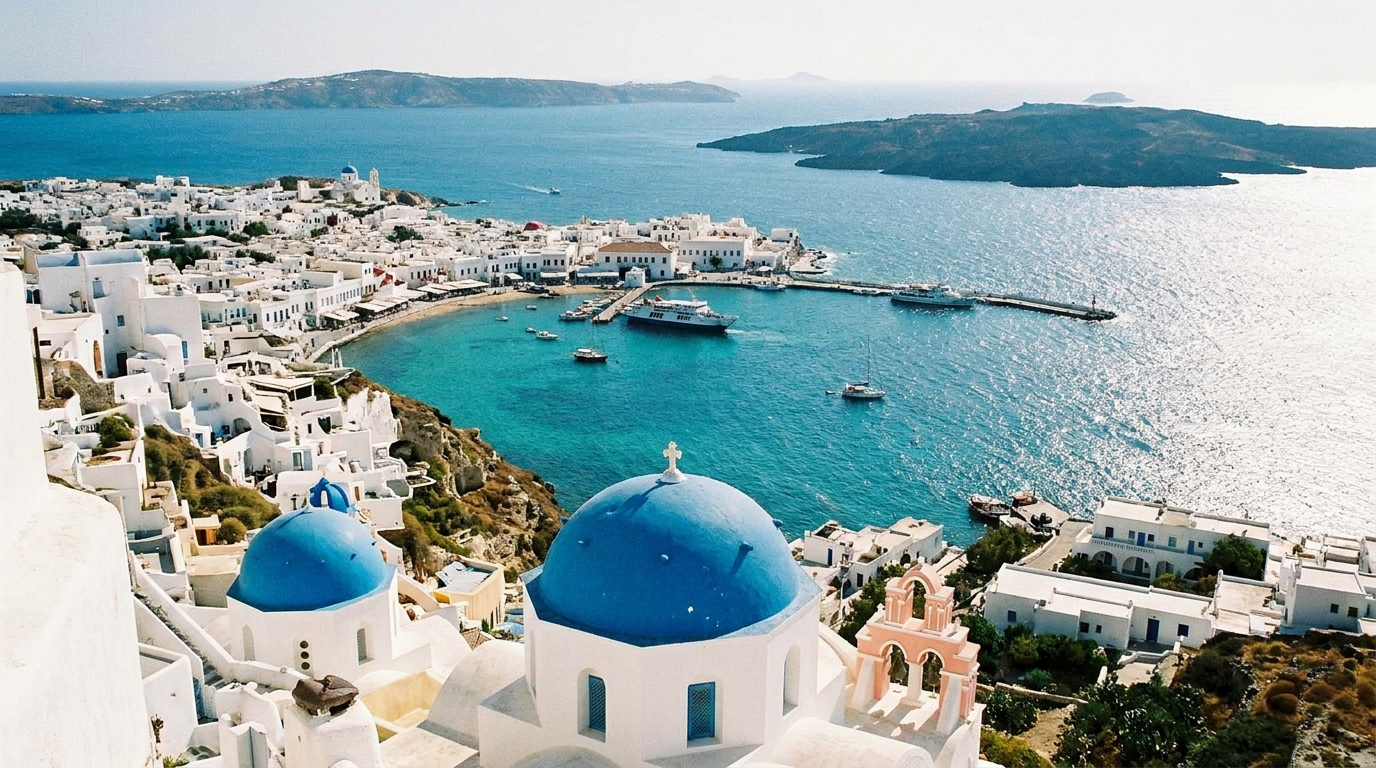
Greek Islands Hopping: A 10-Day Cyclades Route
The Cyclades are the postcard Greece of blue domes and whitewashed cubes, scattered across the Aegean and linked by a dense web of ferries. Ten days lets you mix a famous island or two with somewhere quieter, so you come home with both the iconic sunset photo and the memory of a cove where you were the only one swimming. The route below runs roughly east to west and ends on Santorini, which makes for the easiest logistics and the most satisfying finale.
Days 1–3: Naxos
Start on Naxos, the largest Cycladic island and one of the most well-rounded: a lively port crowned by a marble Portara gateway, a tangle of Venetian old-town lanes, long sandy beaches on the west coast, and green mountain villages inland. Because it grows much of its own food, it's also one of the best islands for eating well — local cheese, potatoes and citron liqueur all come from here.
Three days gives you time to balance beach and exploration. Spend one day on the sand at Plaka or Agios Prokopios, and another driving (a rental car or scooter pays off here) up to hill villages like Halki and Apeiranthos, with a stop at the ancient kouros statues lying abandoned in the fields. Naxos also has frequent ferry links in every direction, which is exactly why it makes such a good first base.
Days 4–5: Paros and Antiparos
A short hop away, Paros balances pretty villages, good beaches and an easygoing pace that sits comfortably between Naxos's calm and the buzzier islands. Base yourself in the chic harbour village of Naoussa, with its little Venetian port and excellent restaurants, or in the more workaday capital of Parikia. Rent wheels to reach beaches like Kolymbithres, with its smooth sculpted rocks, and the windsurfing strands on the east coast.
Take the small, frequent ferry across to tiny Antiparos for a day — it's a ten-minute crossing to a single sleepy town, a famous cave, and beaches that feel a notch quieter than Paros itself. It's the easiest "extra island" you'll add all trip.
Days 6–8: Milos
Milos is the scenery highlight, a volcanic island ringed with surreal, otherworldly beaches. Sarakiniko is the showstopper: a moonscape of wind-smoothed white rock dropping into deep blue water, best seen early morning or near sunset when the light is soft and the crowds thin. Many of the island's most spectacular coves — Kleftiko's sea caves and arches chief among them — are only reachable by boat, so build in a half-day boat tour around the coastline.
Three days lets you slow down and explore. Wander the colourful fishing villages with their syrmata (boat garages painted in bright colours), watch the sunset from the hilltop capital of Plaka, and rent a car to reach the more remote southern beaches. Milos rewards a bit of effort more than the busier islands do.
Days 9–10: Santorini finale
End on Santorini for the famous caldera views and the sunset over the cliffs that draws everyone here. It's the busiest and priciest island on this route, so set expectations accordingly: the magic is real, but so are the crowds. Book accommodation well ahead, and consider staying away from the most congested sunset spot in Oia — the villages of Imerovigli or Firostefani offer the same caldera view with a fraction of the crush.
Use your two days to walk the caldera-rim path from Fira to Oia (do it in the cooler morning), visit the volcanic-ash ruins at Akrotiri, and swim at the unusual Red Beach or off a boat in the caldera. Then catch your flight out of Santorini's airport, which is well-connected for the trip home.
How to get there and get around
Most travellers reach the Cyclades by ferry from Athens' Piraeus port, or by flying into one of the islands with an airport (Naxos, Paros, Milos and Santorini all have one). Flying into Athens, ferrying out to Naxos, and flying home from Santorini is a clean, no-backtracking plan.
Between islands, ferries are the lifeblood of the Cyclades. On the islands themselves, a rental car or scooter is genuinely worth it on Naxos, Paros and Milos to reach the scattered beaches; Santorini is small enough to manage with buses, taxis and walking, and driving there in peak season is more stress than it's worth.
Best time of year
- June and September are ideal: warm sea, full ferry schedules, long days and slightly thinner crowds than peak.
- July and August are hot and busy, with the most ferry departures but also sold-out boats, packed beaches and peak prices — and the meltemi wind can be strong, which affects the fast catamarans.
- May and early October are pleasant and quieter, with a warming or cooling sea and a thinner ferry timetable, so check connections carefully before committing to an island.
Roughly what it costs
The Cyclades span a wide price range, and this route deliberately mixes them. Naxos, Paros and Milos offer solid value, especially for food and mid-range rooms, while Santorini is markedly more expensive for accommodation, sunset-view tables and tours. Ferries are moderately priced — fast catamarans cost more than the larger conventional boats. Travelling in the shoulder season and saving Santorini for just the end are the two easiest ways to keep the budget sensible.
How to adapt the route
- Only have a week? Drop Paros and do Naxos, Milos and Santorini.
- Have two weeks? Add a wilder island like Folegandros or Sifnos (a foodie favourite) between Milos and Santorini.
- Want it slower? Cut one island entirely and give the rest more beach days — island life is best when you're not constantly watching the ferry clock.
- Prefer non-stop nightlife? Swap one stop for Mykonos, though it breaks the quiet-and-iconic balance this route is built around.
What to skip
- Don't try to cram in five or six islands in ten days; the ferry days eat your time and you'll feel like you commuted rather than travelled.
- Skip the Oia sunset crush if crowds aren't your thing — the view is just as good a few streets away.
- Don't book the tightest possible ferry connections; leave buffer in case of weather cancellations.
Practical tips
- Book ferries in advance in July and August, when popular routes sell out, and keep your tickets on your phone as well as on paper.
- Choose your boat type knowingly: faster catamarans cost more and are more affected by wind, while the larger, slower ferries are cheaper and steadier — a real consideration on windy days.
- Always keep your plans a little flexible in case of weather cancellations; the meltemi can ground fast boats for a day.
- Bring water shoes for the pebbly and rocky beaches, and reef-safe sunscreen for the strong Aegean sun.
- Carry some cash for smaller tavernas and beach kiosks, especially on the quieter islands.
The bottom line
Ten days through the Cyclades is the right amount of time to taste both sides of these islands — the easygoing, food-and-beach rhythm of Naxos, Paros and Milos, and the head-turning drama of Santorini at the end. Mix the famous with the quiet, let the ferries dictate a gentle pace, and save the busiest island for last. Do that, and you'll get the iconic blue-and-white postcard and the empty cove that no postcard ever shows.

Sofia is a Naples-based food writer who believes the fastest way to understand a place is through its market and its coffee bar. She covers food and culture across Italy and the Mediterranean for AdriaForum, from black risotto on the Croatian coast to the unwritten rules of ordering an espresso.
More about our writers →More in Itineraries
The Perfect 7-Day Croatia Itinerary
From Dubrovnik's walls to Split's palace and the islands in between — a balanced week-long route down the Dalmatian coast.
Amalfi Coast in a Long Weekend: A 4-Day Plan
Cliffside villages, lemon groves and impossibly blue water — here's how to make the most of four days on Italy's Amalfi Coast.
Two Weeks Across the Balkans by Bus and Ferry
An affordable, scenic overland route through Croatia, Bosnia, Montenegro and beyond — using buses, ferries and your own two feet.