Two Weeks Across the Balkans by Bus and Ferry
The Balkans reward slow, overland travel. Distances are short, buses are cheap and frequent, and the changes in landscape, language and history between neighbouring countries are striking — you can have coffee in a Habsburg café and dinner under an Ottoman bridge in the same week. Here's a two-week route through Croatia, Bosnia and Montenegro that needs no car, just a backpack and a little patience at borders.
Days 1–3: Zagreb and Plitvice
Begin in Croatia's capital, Zagreb, an underrated, walkable city of leafy squares, café terraces and small museums (the Museum of Broken Relationships is a genuine highlight). It's the most Central European stop on the route — all Austro-Hungarian facades and tram bells — and a gentle place to shake off the flight and adjust to the rhythm of travel.
On your way south, break the journey at Plitvice Lakes, Croatia's most famous national park: a chain of turquoise lakes linked by waterfalls and wooden boardwalks. You can do it as a long day trip from Zagreb, but staying overnight nearby lets you arrive at opening time and beat the tour buses, which makes a real difference in summer.
Days 4–6: Split and the islands
Continue to Split by bus and spend a couple of days inside Diocletian's Palace, the 1,700-year-old Roman complex that still functions as the living core of the city, packed with apartments, bars and markets. Walk the Riva waterfront, climb Marjan hill for the view, and use Split as your jumping-off point for the islands.
From the harbour, take a ferry to an island for a slower couple of days. Hvar offers a glamorous harbour town plus a quiet, lavender-scented interior; Vis, further out and long closed to foreigners as a military base, feels wilder and more secretive, with hidden coves and a fishing-village calm. Either way, this is the stretch to swim, eat seafood and slow right down before you head inland.
Days 7–8: Mostar, Bosnia
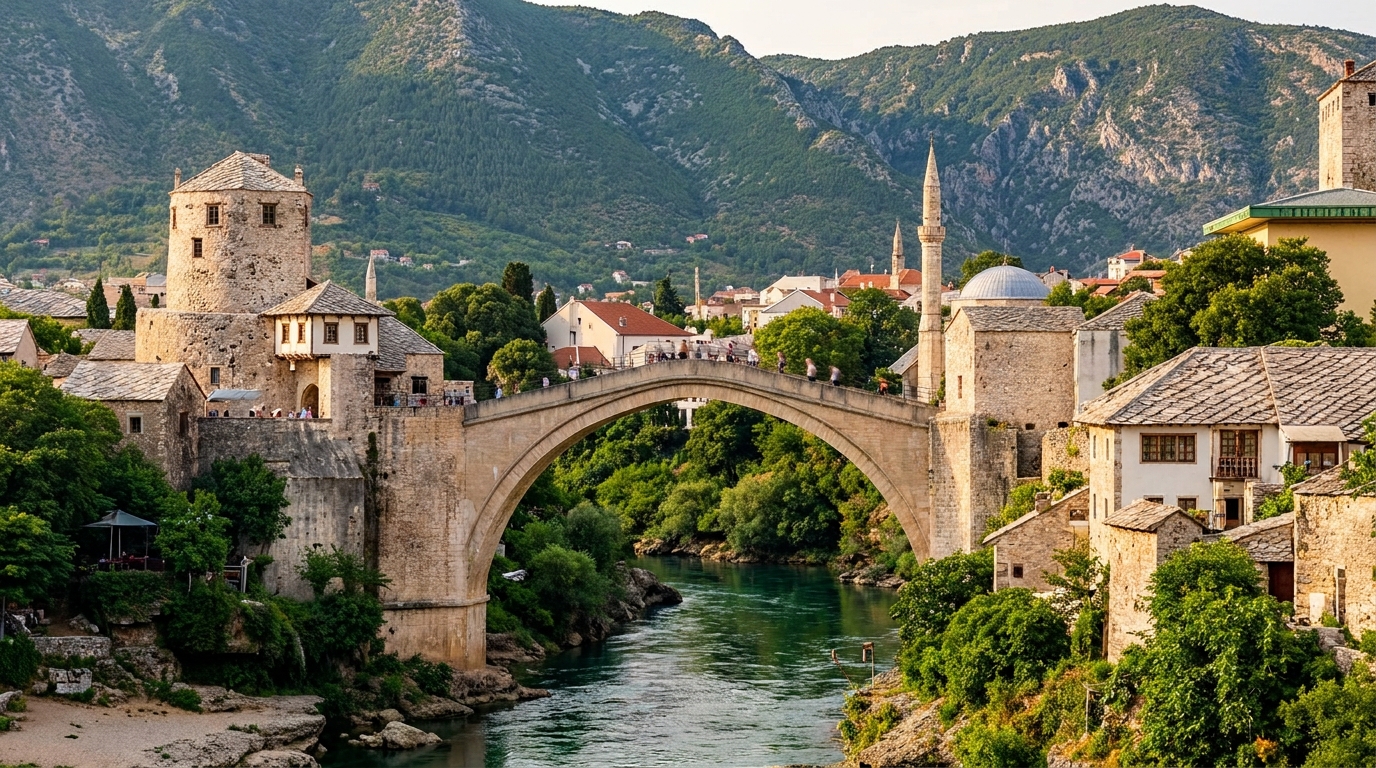
Bus inland and across your first border into Bosnia and Herzegovina to Mostar, where the rebuilt Ottoman Stari Most bridge arches over the impossibly green Neretva river. The bridge — destroyed in the 1990s war and painstakingly reconstructed — is the symbol of the town, and you may catch local divers leaping from it into the cold water below.
Crucially, stay overnight. Mostar empties out when the day-trippers leave in the late afternoon, and the old bazaar in the evening light, with the call to prayer drifting over the rooftops, is when the place feels real rather than staged. If you have a spare half-day, the nearby dervish house at Blagaj and the waterfalls at Kravice are easy add-ons.
Days 9–11: Kotor, Montenegro
Continue south and cross into Montenegro to the fjord-like Bay of Kotor, a deep, mountain-walled inlet of the Adriatic with a medieval walled town at its head. Climb the fortress walls above the old town — a steep, sweaty switchback of around 1,350 steps — for a heart-pounding view straight down onto the red roofs and the bay. Go early or near sunset to dodge the midday heat.
With three days here you have room to breathe. Spend one wandering Kotor's marble lanes and cat-filled squares, and another on the bay's quieter villages — Perast, with its two photogenic islets, is a short bus or boat ride and a calmer counterpoint to Kotor's cruise-day crowds.
Days 12–14: Dubrovnik finale
Loop back up the coast and across one more border to Dubrovnik for your final stretch. After two weeks of buses and ferries, the walled city is a fitting grand finale: walk the city walls (early, before the crowds), swim off the rocks below them, and treat yourself to a celebratory dinner in the Old Town. From here it's an easy flight home, or a short hop back into Croatia proper if you're continuing.
How to get there and get around
Fly into Zagreb and out of Dubrovnik to avoid backtracking — both have good international links. The whole route runs on a combination of:
- Buses, the workhorses of Balkan travel: frequent, inexpensive and the only sensible way to cover the inland legs to Mostar and Kotor.
- Ferries, for the island-hopping out of Split.
- Your own two feet, for the old towns, the park boardwalks and those fortress climbs.
You do not need a car, and not having one frees you from the hassle of cross-border rental rules and city parking.
Best time of year
- May, June and September are the sweet spot: warm, swimmable, and busy without the August crush.
- July and August are hot and crowded, with the most boat departures but the highest prices and the longest queues at Plitvice, Kotor and Dubrovnik.
- April and October are quieter and cheaper, with comfortable hiking weather but a cooler sea and a thinner ferry schedule.
Roughly what it costs
This is one of Europe's better-value routes, but the value is uneven. Bosnia and inland Montenegro are noticeably cheaper than the Croatian coast, where Dubrovnik in particular is expensive. Buses and hostels keep costs down; the splurges are coastal accommodation in peak season and the odd boat tour. Budget travellers can do this comfortably on hostel-and-bus prices, while a mid-range trip still costs less than the equivalent in Western Europe.
How to adapt the route
- Only have 10 days? Cut either the islands or the Zagreb–Plitvice opening and start in Split.
- Have three weeks? Add Sarajevo for its layered, moving history, the Bay of Kotor's coastal walks, or push south to Albania's beaches and mountains.
- Want it slower? Drop one country entirely and give the rest more breathing room — two weeks across just Croatia and Montenegro is a gentler pace.
What to skip
- Don't try to add Belgrade or North Macedonia onto this loop; the detours will swallow days of bus time.
- Skip Mostar as a day trip — the overnight is the whole point.
- Don't over-pack the island stretch with tours; one slow island beats two rushed ones.
Practical tips
- Buy bus tickets a day ahead in summer, especially on popular legs like Split–Mostar and Kotor–Dubrovnik.
- Carry some cash for border-town stops, small cafés and bus-station fees, and note that you'll move through several currencies — the euro in Croatia and Montenegro, the convertible mark in Bosnia.
- Keep your passport handy: you'll cross several borders, each with its own stamp and the occasional wait while the bus is checked.
- Travel with a carry-on or backpack — you'll be hauling it on and off buses and over cobbles.
- Download offline maps and a bus app like GetByBus or FlixBus before you go; schedules and stations aren't always obvious.
The bottom line
Two weeks across the Balkans by bus and ferry is one of the most rewarding overland trips in Europe — a string of Roman, Ottoman, Venetian and socialist-era layers packed into short, cheap journeys between countries that feel genuinely different from one another. Go in the shoulder season, stay overnight where the day-trippers don't, and let the buses set a pace that leaves room for the unplanned coffee, the unexpected swim and the conversation at the next border crossing.

Ivan plans the routes. A lifelong hiker based in Zagreb, he has walked the boardwalks of Plitvice and Krka in every season and mapped out countless Croatia and Balkans road trips for friends before turning it into a job. He writes our itineraries and national-park guides.
More about our writers →More in Itineraries
The Perfect 7-Day Croatia Itinerary
From Dubrovnik's walls to Split's palace and the islands in between — a balanced week-long route down the Dalmatian coast.
Amalfi Coast in a Long Weekend: A 4-Day Plan
Cliffside villages, lemon groves and impossibly blue water — here's how to make the most of four days on Italy's Amalfi Coast.
Greek Islands Hopping: A 10-Day Cyclades Route
Whitewashed villages, volcanic beaches and ferry rides between them — a relaxed ten-day loop through the Cyclades.