Croatian Food 101: 12 Dishes You Have to Try
Croatian food is really several cuisines stitched into one country. The Adriatic coast leans Italian and Mediterranean, all olive oil and seafood, while the inland regions show their Central European and Ottoman past in heavier stews and grilled meats. Eat your way from the sea to the hills and you'll taste the borders shift under your fork.
How to read a Croatian menu
Before the dishes, a few words on how eating works here. Lunch (ručak) is the traditional main meal, often eaten in the early afternoon, though tourist towns serve all day in summer. A proper restaurant is a restoran; a konoba is the cozier, family-run tavern you actually want — wooden benches, a short handwritten menu, and whatever the owner cooked that morning. A gostionica sits somewhere in between.
Portions are generous and prices on the coast can climb fast, especially for fish, so it pays to understand a couple of conventions:
- Fish and seafood are usually sold by weight (per kilogram), then weighed in front of you. Always ask the price per kilo and roughly how much a portion weighs before you commit.
- Couvert (a small bread-and-cover charge) is common and normal; it's not a scam.
- Tap water is fine, but you'll often be steered toward bottled. Asking for "voda iz slavine" (tap water) is perfectly acceptable.
On the coast
The Dalmatian and Istrian coast is where Croatia feels most Mediterranean. Cooking here is deliberately simple, built on the idea that good olive oil, a fresh catch, and a squeeze of lemon don't need much help.
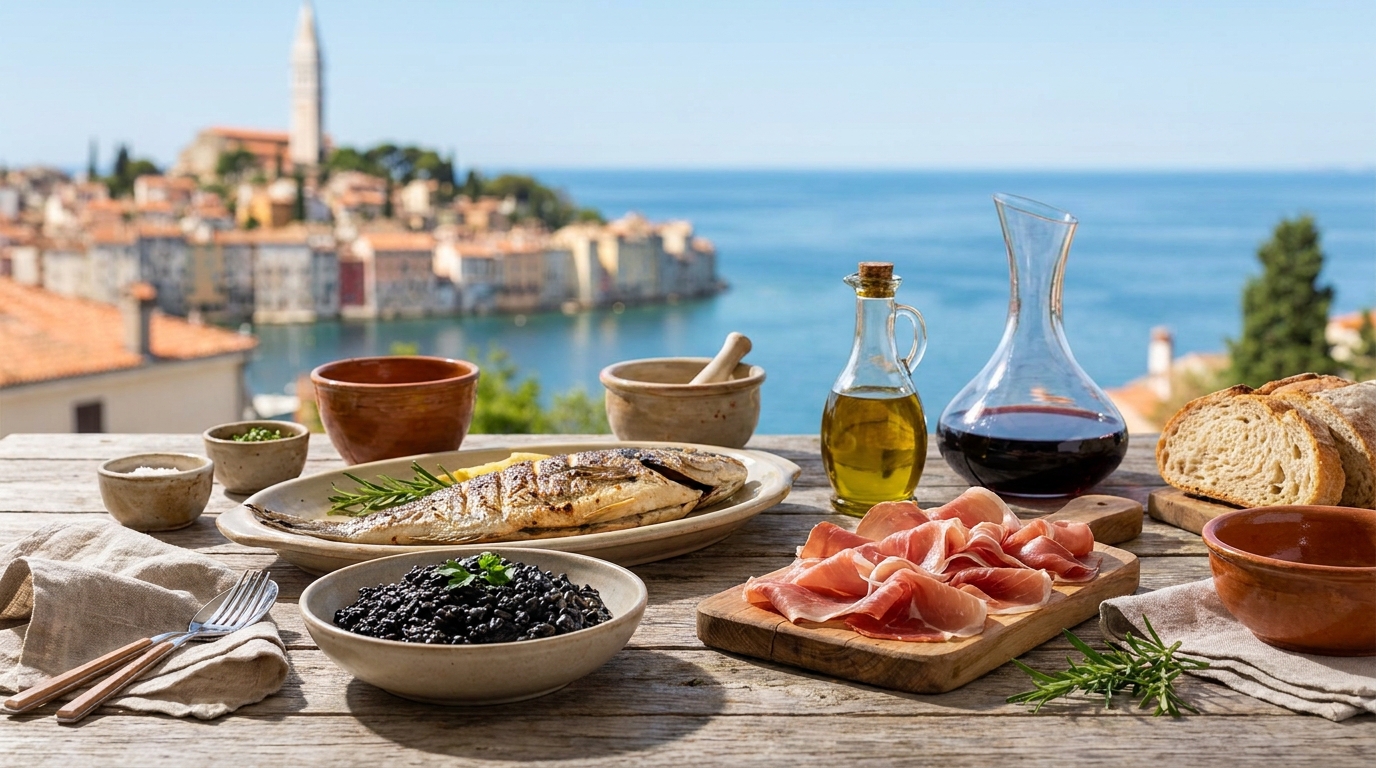
Black risotto (crni rižot)
Black risotto gets its dramatic ink-dark colour and deep, briny flavour from cuttlefish or squid ink. It's rich and a little salty-sweet, the seafood equivalent of comfort food. Order it as a starter to share — a full portion is heavier than it looks — and don't wear a white shirt. Yes, it will stain your teeth a bit; that's part of the fun.
Grilled fish (riba s gradela)
Grilled fish, simply dressed with olive oil, garlic and lemon, is the coastal staple. Common species include orada (gilt-head bream), brancin (sea bass), and lubin. Whole fish grilled over wood or charcoal is the classic preparation, usually served with blitva — Swiss chard sautéed with potato, garlic and olive oil. A good rule: the simpler the fish dish, the fresher the fish needs to be, and the best konobas know it.
Peka
Peka is the coastal showstopper: meat (often veal or lamb) or octopus and vegetables slow-cooked under a bell-shaped iron lid (the peka itself) buried in glowing embers. The result is meltingly tender with a smoky edge. Because it takes hours, you almost always have to order it a day or several hours ahead, often for a minimum of two people. Building a meal around a peka is one of the great Croatian dinner experiences — call ahead and treat it as the event it is.
Buzara and brodet
Two more coastal essentials worth seeking out: buzara, mussels or shrimp quickly cooked in white wine, garlic and parsley (with or without tomato), eaten with bread to mop the broth; and brodet (or brudet), a slow fisherman's stew of mixed fish in tomato and wine, traditionally served over polenta.
Inland and hearty
Cross into the continental north and the food turns warmer, richer and more Central European.
Štrukli
In Zagreb and the Zagorje region, look for štrukli — thin dough filled with fresh cottage cheese, then either baked until golden or boiled and served in a soupy, buttery sauce. The baked version is the crowd-pleaser; the savoury-but-faintly-sweet boiled one is the old-school comfort dish. It works as a starter, a side, or a meal.
Ćevapi
Ćevapi, small grilled minced-meat sausages, are a Balkan-wide favourite served with somun (a soft flatbread), raw chopped onion, and ajvar, a red pepper relish. They're everywhere, cheap, and genuinely satisfying — order them in fives or tens. Don't overthink it; this is honest grill food.
Other inland classics
- Zagorski štrukli aside, the north loves its game and slow-cooked meats. Try purica s mlincima (roast turkey with baked flatbread strips), a Zagreb Sunday classic.
- In Slavonia, the far east, kulen (a spicy paprika-laced cured sausage) and fiš paprikaš (a fiery freshwater-fish paprika stew) show the Hungarian influence.
Cured and preserved
Pršut, Dalmatian dry-cured ham, rivals Italian prosciutto. Istrian pršut is typically dried by the bora wind without smoking, while Dalmatian versions are often lightly smoked — both are excellent. It's classically served with paški sir, a sharp, hard sheep's cheese from the island of Pag, where the sheep graze on salt-sprayed, herb-covered scrubland that flavours the milk. A plate of pršut, paški sir, olives and bread is the perfect coastal starter.
Truffles and Istria
Worth its own mention: Istria, the peninsula in the northwest, is truffle country. From roughly autumn into early winter, white and black truffles turn up shaved over fuži (a hand-rolled local pasta), eggs, and steak. Istria also makes some of the country's best olive oils — internationally awarded — so build in time to taste here if you can.
Sweet things
Finish with rožata, a Dubrovnik custard pudding similar to crème caramel but scented with rose liqueur or citrus. Around holidays and festivals, look for fritule — little fried doughnuts dusted with sugar, sometimes studded with raisins and a splash of rakija. On the islands, you might also find rožata's cousins and almond-heavy cakes that nod to the Venetian past.
Drinks
Wash it all down with Croatian wine, which is far better than its modest international profile suggests:
- The coast's signature red is plavac mali, producing bold, sun-baked reds (Dingač and Postup from the Pelješac peninsula are the prestige names).
- Pošip and malvazija (Istrian Malvasia) are the standout whites.
- Order the house wine (vino) by the carafe at a konoba — it's usually local, cheap, and good.
Then there's rakija, a strong fruit brandy offered as a welcome on arrival or a digestif after dinner. Common types include šljivovica (plum), travarica (herb-infused), and lozovača (grape). Accepting a small glass when it's offered is a friendly gesture; just pace yourself, because hosts are generous.
Practical tips
- Reserve peka and other slow-cooked dishes ahead — same day at the earliest, ideally the day before.
- Ask the price of fish by weight and confirm the portion size before ordering.
- Eat at a konoba over a flashy waterfront restoran when you can; the food is usually better and cheaper a street or two back from the promenade.
- Go where the menu is short and seasonal. A handwritten daily list beats a laminated photo menu in ten languages.
- Say "živjeli!" (cheers) when you toast, and make eye contact — it matters here.
- Tipping is modest: rounding up or leaving around 10% for good service is plenty.
The bottom line
Croatia rewards travelers who eat with the geography in mind: order fish, shellfish and risotto by the sea, and meat, stews and štrukli inland. Seek out family konobas, plan a peka dinner in advance, and don't leave without a plate of pršut and paški sir and a glass of plavac mali. Do that, and you'll taste why Croatian food deserves a place alongside its more famous Mediterranean neighbours.

Maja grew up in Split and has been writing about the Dalmatian coast for over a decade. She spends her summers island-hopping by ferry and her winters tracking down the konobas and viewpoints the tour buses miss. She covers our destination guides for Croatia and the wider Adriatic.
More about our writers →More in Food & Culture

How to Order Coffee Like a Local in Italy
Italian coffee comes with unspoken rules. Learn a few and you'll order with confidence — and avoid a few quiet faux pas.
A Traveler's Guide to Mediterranean Markets
Markets are the fastest way to understand a place's food and rhythm. Here's how to shop them like you belong.
Summer Festivals Along the Adriatic Coast
From centuries-old theatre festivals to seaside music nights, the Adriatic summer is one long celebration. Here's what to look for.