How to Travel Carry-On Only for Two Weeks
Traveling with only a carry-on used to feel like an extreme sport. With a little discipline it's the most relaxed way to move — no baggage fees, no waiting at the carousel, and no lost luggage. After years of doing two-week Adriatic trips out of a single bag, I've learned that packing light is less about willpower and more about having a system you trust.
Why carry-on only is worth it
The obvious wins are money and time: you skip checked-bag fees on every flight, walk straight off the plane, and never stand at a silent carousel watching other people's suitcases go round. But the quieter benefit is mobility. When everything you own fits on your back, you can hop a catamaran from Split to Hvar, walk fifteen minutes over cobblestones to a guesthouse, or change plans on a whim without dragging a wheelie case up a flight of stone steps. On the Dalmatian coast, where half the charm is in places cars and porters can't reach, that freedom matters.
Build a capsule wardrobe
Pick a colour palette where everything mixes. For two weeks, that's roughly five tops, two or three bottoms, a light layer, and one "nice" outfit. You will re-wear things, and that's fine — nobody on your trip is keeping track.
The trick is that every item should work with every other item. Choose two or three base colours — navy, olive, grey, sand — and let one accent piece add personality. A concrete starting list for a warm-weather coastal trip:
- 5 tops (mix of t-shirts and one or two collared or smarter shirts)
- 2 bottoms (one versatile trousers/shorts, one that dresses up)
- 1 light layer (a cardigan, overshirt, or packable jacket)
- 1 swimsuit (two if you swim daily — they're tiny)
- 1 "nice" outfit for a dinner out
- Underwear and socks for about 5 days, plus laundry
- 1 pair of comfortable walking shoes, 1 pair of sandals or smart shoes
If an item doesn't earn its place in at least three outfits, leave it home.
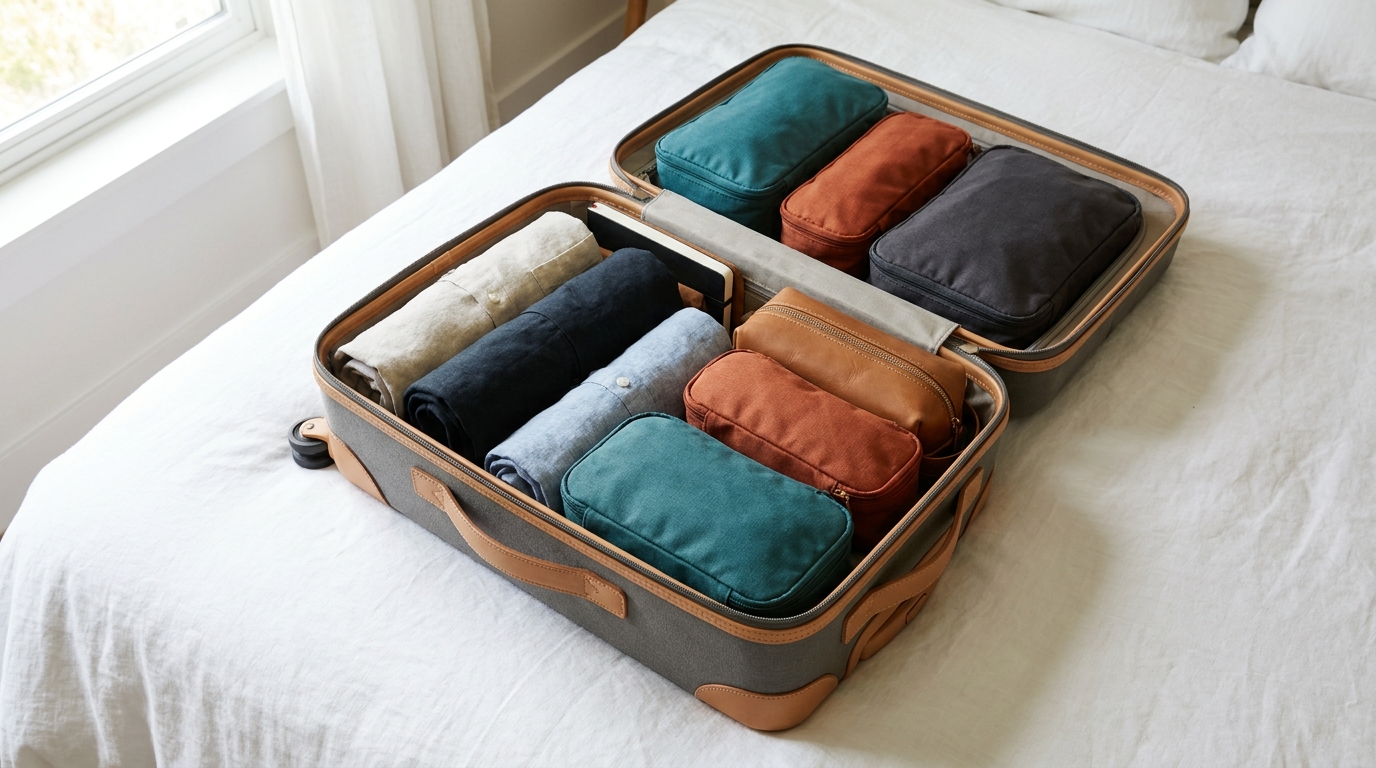
Roll, then use packing cubes
Rolling clothes saves space and reduces creases. Two or three packing cubes turn a chaotic bag into organised compartments, and a compression cube can shrink bulky items noticeably.
Use the cubes as a filing system, not just storage. A simple split that works:
- Tops cube — all shirts, rolled vertically so you can see every one at a glance.
- Bottoms and layers cube — trousers, shorts, and your light jacket.
- Smalls cube — underwear, socks, swimwear.
- Compression cube — anything bulky, squeezed flat.
The payoff comes mid-trip: you never excavate the whole bag to find one shirt, and repacking each morning takes thirty seconds.
Wear your bulkiest items
On travel days, wear your heaviest shoes and jacket rather than packing them. It feels slightly silly boarding in your boots, but it frees up a surprising amount of space and weight.
Shoes are the worst offenders — a single pair can eat a quarter of a carry-on. Wearing your bulkiest pair and packing only one lighter alternative is the highest-leverage move in light packing. Same with the jacket: wear it through security, then ball it into the overhead bin or use it as a pillow.
Do laundry on the road
The secret to packing light for any length of trip is washing along the way. A small bottle of travel detergent and a sink will handle underwear and shirts; most apartments and many hostels also have laundry facilities.
A practical rhythm is a quick sink-wash every few nights for small items, and one proper laundry session around the halfway point. To make sink-washing painless:
- Wash in the evening so things dry overnight.
- Wring clothes inside a dry towel before hanging — it cuts drying time dramatically.
- Pack a few feet of paracord or a flat travel clothesline; bathroom rails and balcony railings do the rest.
- Quick-dry, merino, and synthetic fabrics dry by morning. Heavy cotton may not, so favour the former.
In coastal Croatia, dry summer air is your ally — a rinsed shirt on a balcony in Hvar is wearable by breakfast.
Limit the liquids
Switch to solid toiletries — bar shampoo, solid sunscreen — to dodge the liquids limit entirely, and decant anything else into 100ml bottles. You can buy more at your destination if you run out.
The standard cabin rule is liquids in containers of 100ml or less, all fitting in a single transparent resealable bag of about a litre. Solids sidestep the rule completely, so the more you can switch, the less you have to fuss at security:
- Bar shampoo and conditioner, solid soap
- A solid or stick sunscreen, plus a small decanted bottle for backup
- Toothpaste tablets or a travel tube
- A roll-on or solid deodorant
Remember you can buy bulky, cheap, replaceable things — sunscreen, more soap, water — when you arrive. Don't pack two weeks of everything; pack enough to start.
A pre-flight checklist
Run through this the night before:
- Bag weighed and within your airline's cabin limit (check the exact dimensions and weight for your specific airline — budget carriers are strict).
- Liquids in the clear bag, easy to pull out at security.
- Passport, cards, phone, charger, and any medication in an easy-access pocket — never in the bag you might be asked to gate-check.
- A copy of bookings saved offline.
- Bulkiest shoes and jacket set aside to wear.
Frequently asked questions
Will it really last two weeks? Yes, as long as you commit to doing laundry. The wardrobe doesn't need to be bigger; the cycle of re-wearing and washing is what extends it.
What about a personal item? Most airlines allow a small personal item alongside the carry-on. Use it for your "essentials" — documents, electronics, a book, snacks — so the main bag holds clothes.
What if airlines force me to gate-check the bag? On full budget flights it happens. Keep valuables, medication, and one day's essentials in your personal item so a gate-check never strands you.
Won't I look like I'm wearing the same thing in every photo? A capsule wardrobe mixes enough that you won't — and even if you re-wear a favourite shirt, your future self looking back at the trip won't care.
Practical tips
- Lay everything out, then remove a third. People almost always overpack on the first attempt.
- Pack to a fixed bag, not a fixed list — if it doesn't fit, it doesn't come.
- Choose multipurpose items: a sarong is a beach towel, a blanket, and a cover-up; a light scarf is a layer and a pillow.
- Keep a small "open me first" pouch with chargers, adapters, and a toothbrush so you're functional the moment you land.
- Leave a little empty space for the inevitable thing you buy along the way.
The bottom line
Carry-on-only travel isn't about deprivation — it's about carrying only what genuinely serves the trip. Build a mixable capsule, pack it into cubes, wear your bulkiest pieces, wash as you go, and switch to solids. Do that once and you'll never willingly check a bag for a two-week trip again.

Elena has travelled to more than 40 countries, almost always with a single carry-on. She writes our practical travel-tips pieces — packing, staying safe as a solo traveller, and the small habits that make trips smoother. She's currently based in Lisbon between trips.
More about our writers →More in Travel Tips
7 Simple Ways to Avoid Tourist Traps Abroad
A few habits separate a memorable meal from an overpriced letdown. Here's how to spot and sidestep tourist traps.
Travel Insurance Explained: What You Actually Need
Travel insurance is confusing on purpose. Here's a plain-language breakdown of what the cover actually means and how to choose a policy.
Solo Travel Safety: Practical Habits That Keep You Safe
Solo travel is overwhelmingly safe and rewarding. These low-effort habits reduce the small risks that do exist.